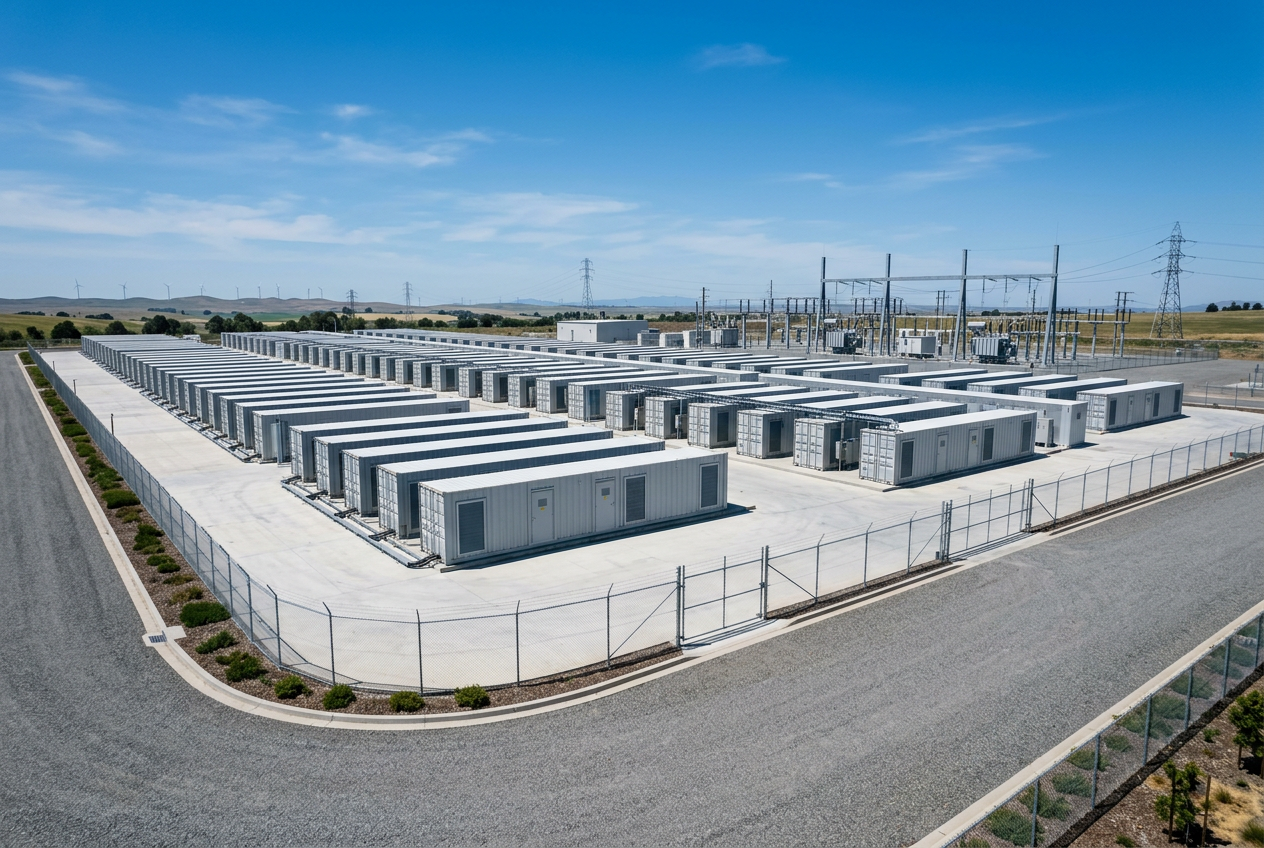
Grid-scale battery storage is one of the fastest-growing segments of the energy transition — and it's creating a new opportunity for commercial landowners. This guide explains how battery hosting works, why it's concentrated in certain markets, and how to evaluate whether your property could qualify.
What is battery hosting?
Battery hosting is when a landowner or facility operator leases space — land or, in some cases, rooftop — to a developer who installs and operates a battery energy storage system (BESS). The host earns lease or partnership income while the developer monetizes the battery in the energy market.
Battery-hosting evaluation is currently offered in Texas and Illinois only, where market and grid conditions make projects viable.
Why storage is expanding now
As grids add renewable generation, they need flexibility to store energy when it's abundant and release it when it's scarce. Batteries provide exactly that. Markets like ERCOT in Texas have seen record battery interconnection, and the Illinois grids are following.
Batteries earn revenue by charging when power is cheap and discharging when it's valuable, and by providing grid services like frequency response. That revenue potential is what funds attractive lease payments to hosts.
What makes a good hosting site
Developers evaluate several factors when screening a site:
- Location within a supported market (currently Texas or Illinois).
- Available acreage or suitable rooftop space.
- Proximity to substations and transmission infrastructure.
- Available interconnection capacity on the local grid.
- Site access, zoning, and environmental suitability.
Even relatively modest commercial sites can qualify if they're in the right location near grid infrastructure.
How the process works
- 1Screening: confirm the site is in a supported market and gather property details.
- 2Evaluation: assess grid proximity, interconnection, and suitability.
- 3Opportunity model: outline potential lease structures and revenue ranges.
- 4Developer matching: connect with credible, vetted developers.
- 5Negotiation: advise through terms to a signed agreement.
Advantages and considerations
Advantages
- A new, long-term income stream from underutilized land or rooftop.
- Minimal operational burden — the developer builds and operates the system.
- Support for grid reliability and the energy transition.
Considerations
- Projects depend on interconnection availability, which varies by location.
- Timelines can be long, from evaluation through construction.
- Lease terms and structures should be reviewed with an advisor.
Common misconceptions
- "My site is too small" — location near grid infrastructure often matters more than sheer size.
- "I'll have to operate the battery" — the developer handles construction and operations.
- "It's available everywhere" — hosting evaluation is currently limited to Texas and Illinois.